
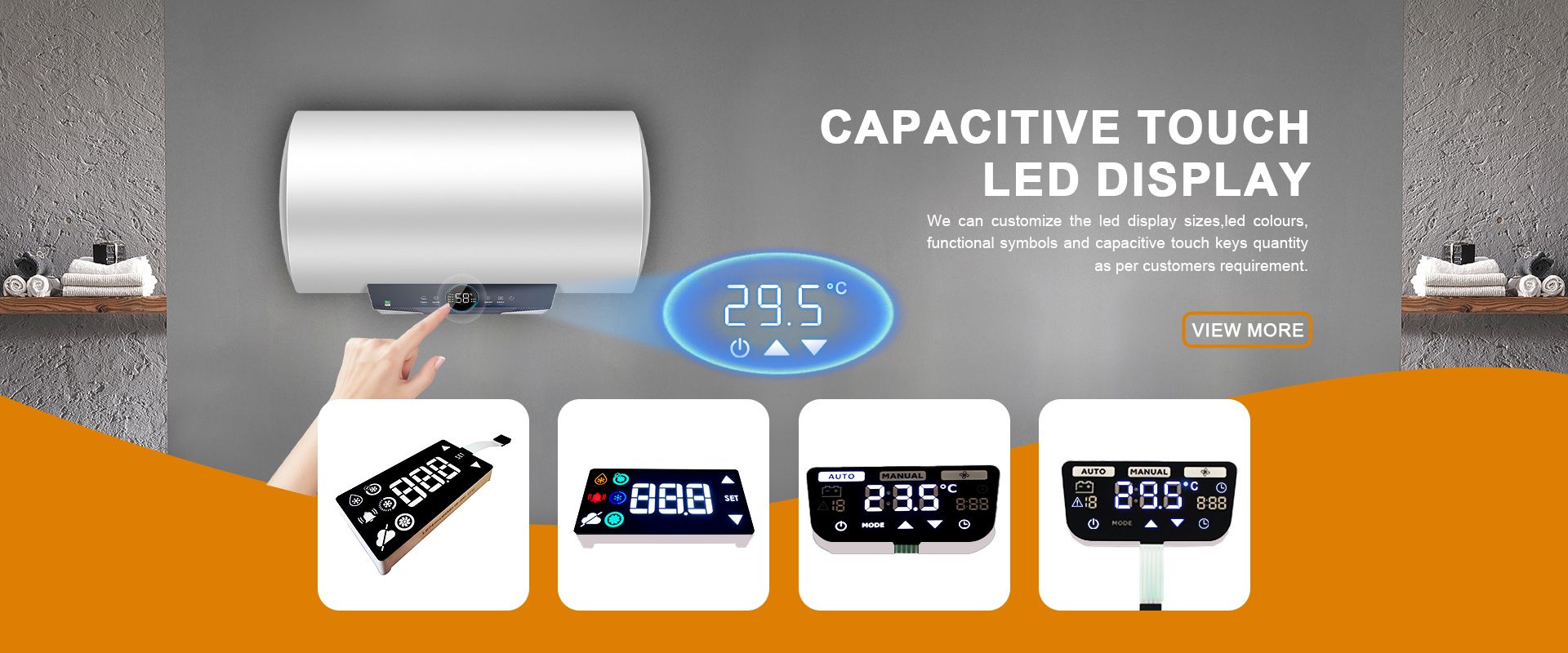
How to Spec a Custom Alphanumeric LED Display: Buyer’s Checklist
Time : Nov 26, 2026 Ansicht : 37
A standard 7-segment display needs three decisions: digit height, colour, pinout. An alphanumeric display multiplies those. The segment count, the character set, the driver interface, the polarity, the mechanical envelope, and the environmental rating each lock in a downstream cost or a schedule commitment, and getting one wrong means a tooling re-spin or a firmware rewrite. This checklist walks through the items to pin down before requesting a quote, in the order they affect the design.
Use it as a pre-RFQ document. Fill in the blanks, send it to the supplier, and the first quote should be close to final. The goal is to reduce clarification rounds, because every round adds time and can shift the price.
Segment Count and Character Set
The segment count is the first spec. Fourteen segments cover the full A-Z alphabet in a compact form. Sixteen segments add a second diagonal to each digit, which sharpens letters like B, S, and W and gives more room for custom symbols. If the panel needs a company logo or a proprietary icon, start from the sixteen-segment base.
The character set is the second. List every letter, digit, symbol, and status icon the panel must show. A temperature readout needs digits, a decimal point, and a degree symbol. A mode indicator needs a few letters and a status bar. The more characters in the set, the more segments are active per frame, and the higher the current draw. Keep the set as small as the application allows, because every extra segment is a current cost and a routing cost on the PCB. A 14-Segment-LED-Anzeige is the common starting point for panels that need the full alphabet plus a small set of symbols.
Driver Integration and Pin Budget
The driver architecture is the spec that most affects the PCB. A direct-drive module exposes one pin per segment plus one per digit. A 16-segment, four-digit module needs up to eighty segment lines plus four digit lines. That is a high pin count, and the routing gets crowded.
An integrated driver IC collapses the interface. The TM1637 uses two control lines. The HT16K33 uses three over I2C. The MAX7219 uses three over SPI. The MCU sends a data packet and the driver decodes it into the correct segment pattern. For a low-pin MCU or a product where the display is one of several peripherals, the integrated driver is usually the right call.
State the preferred driver IC and the interface protocol in the RFQ, or ask the supplier to recommend one that matches the MCU. If replacing an existing display, provide the current driver part number and the pinout, and ask for a drop-in module with the same interface to avoid a firmware change.
Pinout, Polarity, and Mechanical Fit
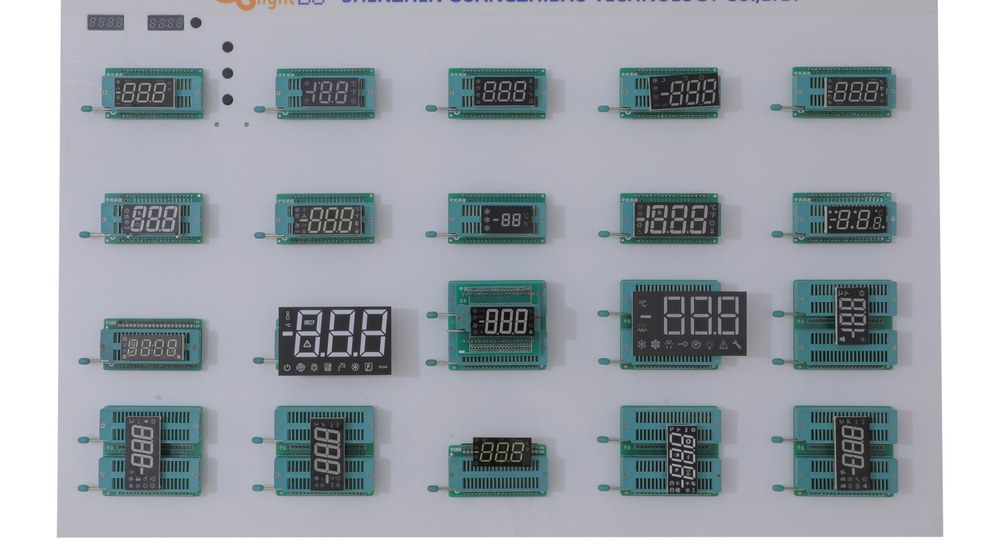
Pinout is the physical mapping of segments and digits to the connector. Two modules with the same segment count can have different pinouts, and the wrong one means a PCB re-spin. Specify the connector type, the pin pitch, and the pin-out order, or provide a board drawing and ask the supplier to match it.
Polarity is the second mechanical spec. Common-anode modules share a single anode; common-cathode modules share a single cathode. The choice depends on the driver IC and the MCU GPIO logic. State the polarity explicitly. A supplier that offers both can match either, but a supplier that offers only one will need a driver change to fit the other.
The mechanical envelope covers the outline dimensions, the mounting method, the lens style, and the mounting hole pattern. For a custom part, provide the board cut-out dimensions and the stack-up height, and confirm the module fits without interfering with adjacent components.
Environmental Rating and Current Budget
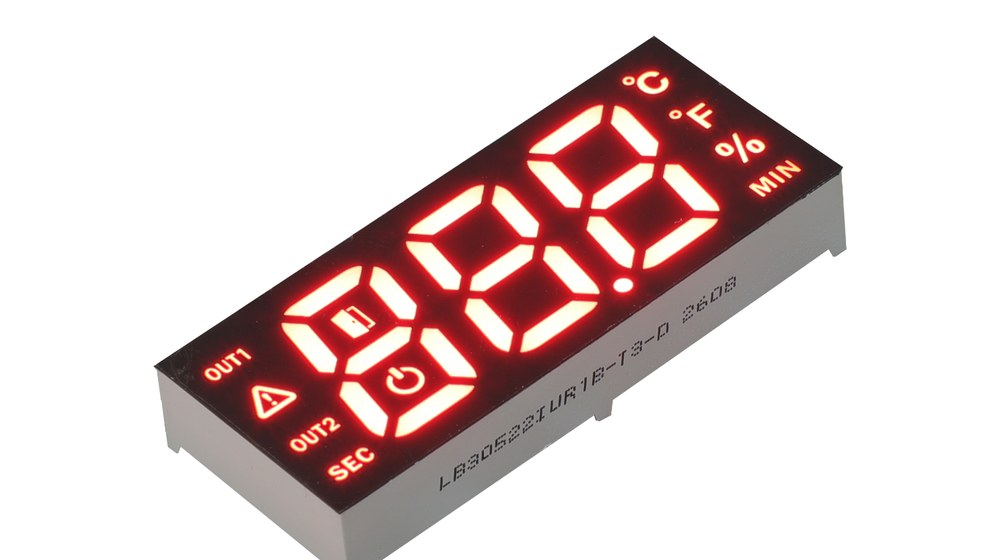
State the operating temperature range, the storage range, and any humidity or vibration requirements. An industrial panel in a machine enclosure may need the full -40 to +85 C range; a consumer appliance may need only 0 to +50 C. The wider the range, the more the part cost moves, because the lens material, the encapsulation, and the LED part selection all shift.
Current budget matters for battery-powered or thermally constrained products. A segment display draws current only in the lit segments, so the worst case is all segments on. Specify the maximum drive current per segment and the multiplexing ratio, and confirm the total display current fits the power budget. A sixteen-segment, four-digit module at full brightness can draw several hundred milliamps, which is significant on a battery.
Packaging and Compliance
The packaging format affects the assembly line. Surface-mount modules are placed and reflowed with the other SMD components. Through-hole modules are inserted and wave-soldered. If the line is already set up for one process, matching it avoids a second soldering station. If the product uses both SMD and THT components, the display packaging can follow whichever is simpler for the module footprint.
Compliance is not optional for export. RoHS restricts six substances; REACH adds a longer list of substances of very high concern. A compliant supplier provides a declaration of conformity and, on request, a material declaration. Confirm the scope covers the specific region of sale, because some markets add local restrictions on top of the EU baseline.
Packaging the RFQ
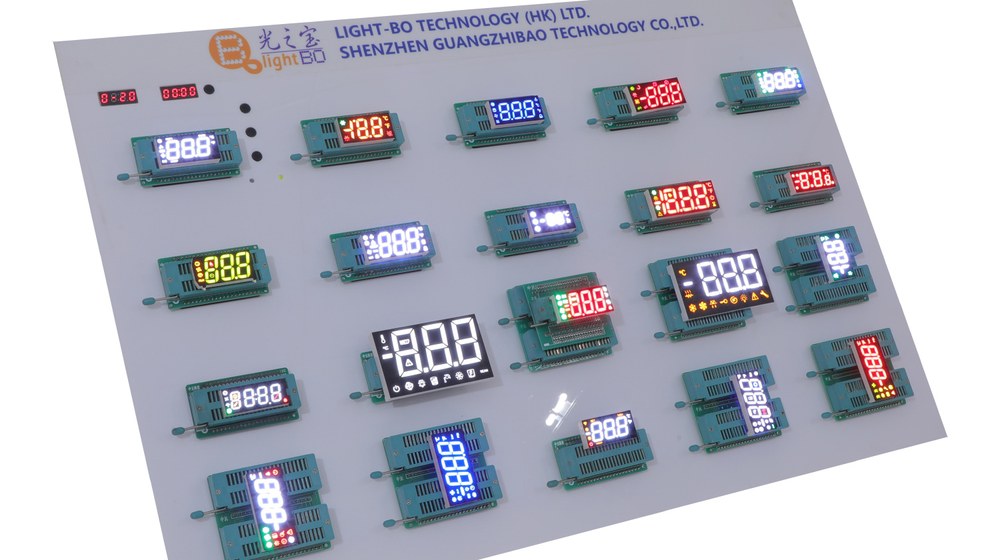
The fastest path to an accurate quote is a one-page spec: segment count and character set, driver IC and interface, pinout and polarity, outline and mounting, operating temperature, drive current, colour, and packaging. Attach a board drawing. If replacing an existing display, include the old part number and a photo of the current module.
A standard module from a catalogue can be quoted in a day. A custom module with a specific pinout, segment layout, and integrated driver takes longer because the engineering team has to design the part. The more complete the spec, the fewer clarification rounds, and the closer the first quote is to the final price. LIGHTBO carries a range of custom LED display modules across both SMD and through-hole packages, and the engineering team can work from a partial spec to close the open items.
If the spec is not fully defined yet, send what is available. A supplier with in-house design capability can work from a partial spec, flag the open items, and propose a solution that fits the board and the budget. Reviewing your requirements before the first contact is often faster than closing every detail internally.
Schlussfolgerung
Specifying a custom alphanumeric display is a sequence of decisions, and each one constrains the next. Fix the segment count and character set first, because they define the tooling. Then the driver IC and interface, because they set the pin budget. Then the pinout, polarity, and mechanical envelope, because they define the board. Finally, the environmental rating, current budget, packaging, and compliance. A buyer who walks through the checklist in that order gets a quote that is close to final, and a part that fits the board the first time.
FAQ (häufig gestellte Fragen)
Q: What is the minimum order quantity for a custom alphanumeric display?
A: It depends on the segment count, the driver integration, and whether the tooling is shared with another customer. A custom module with a unique tool has a different MOQ than one that uses an existing tool. State the expected volume in the RFQ and the supplier will confirm the applicable MOQ and the tool cost.
Q: Can an existing driver IC drive a custom segment layout?
A: In many cases, yes. If the segment count and multiplexing ratio fit what the driver IC supports, the custom layout can be wired to the same IC. The TM1637, HT16K33, and MAX7219 each have a maximum segment and digit count. Confirm the totals fit, and the custom layout can use the same driver without a firmware change.
Q: How long from spec to sample for a custom alphanumeric display?
A: The timeline covers design, tooling, a sample build, and a design check. The exact duration depends on the segment layout complexity and whether the tooling is new or shared. Request a timeline in the quote and plan the product schedule around the sample arrival, because the firmware and mechanical teams test against the physical sample, not the drawing.
Q: Can the display show a company logo?
A: Yes. A custom segment layout can include a dedicated segment shape for a logo or a proprietary icon. The logo is rendered as a set of lit segments, not a bitmap, so it stays crisp at any viewing angle. Provide the logo artwork in vector format, and the supplier maps it to the available segment positions on the chosen base.


